A Slow Lane Walk for Noticing Boundaries
Plan a slow lane walk that turns gates, changing surfaces and bends into useful landmarks, so a familiar rural route feels easier to read on foot.
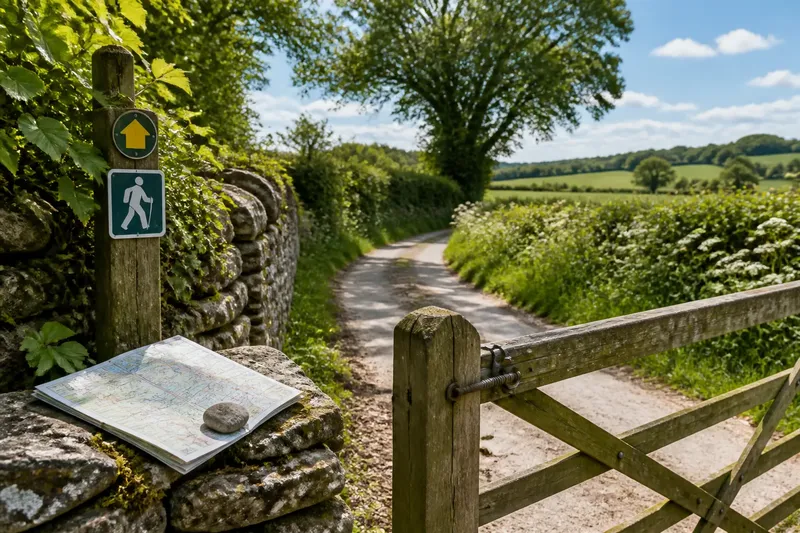
A slow lane walk can begin at the village noticeboard, where the lane leaves the last row of houses and narrows beside a hedge. The gate ahead is not an invitation to enter; it is a useful point to pause, check the route and notice where one stretch of public way gives way to another. A familiar lane becomes more legible when its boundaries are treated as features, not inconveniences between destinations.
What counts as a boundary?
On a rural lane, a boundary may be a stone wall, a drainage ditch, a line of trees, a change in verge or a gate across a track. Some mark property, some manage livestock or water, and some simply make the edge of a route visible. Their practical purposes overlap, but they do not all tell you the same thing about access.
Keep three ideas separate: the physical edge, the route you may use and the land beyond it. A gate can sit on a public footpath, a private drive or a field entrance; its presence alone does not settle which. Look for a public-right-of-way sign, a map, a waymark or another clear indication before continuing. A boundary is a prompt to pay attention, not a permission slip.
For this kind of walk, choose a lane you already know and give yourself room to turn back. Let one or two boundary features shape the outing rather than trying to collect every gate and wall along the way.
How should I plan a slow lane walk?
Begin with a map that shows public footpaths and bridleways, such as an Ordnance Survey map, and identify a short out-and-back route on a lane with a clear starting point. An out-and-back avoids the need to improvise a link across private land if a path is closed or unclear. Check local notices before setting off, then decide which visible changes you want to notice: a metalled surface becoming gravel, a hedge opening at a gate, or a bend that hides the next section.
Leave the route deliberately loose in pace, not in access. You can stop at a verge or other place that does not obstruct walkers, vehicles, farm work or access to a gate. Avoid stepping onto crops, crossing a closed gate or blocking a track while looking at a map. If the lane is narrow or busy, use a safer alternative rather than treating a bend as a viewing point.
Say you usually walk from the bus stop to the chapel and back at a brisk pace. For a slower outing, you might set the chapel as the turn-around point, pause at the signed footpath junction, and notice where gravel gives way to tarmac on the return. The expected result is a route remembered by its transitions, without adding an uncertain crossing or a detour through a field.
What should I notice at a gate?
First, notice what the gate appears to serve. A broad farm gate may allow machinery through; a smaller latch gate may accommodate walkers. Nearby signs and waymarks matter more than appearance. Do not assume that an open gate means the public may pass, or that a closed one means a public path is unavailable.
If you are on a marked public route, follow any instructions on signs and leave the gate as you find it, unless a notice says otherwise. Keep clear of livestock and do not lean on hinges or fencing. The useful observation is often the relationship between the gate, the lane and the marked route: does the way continue straight, turn sharply, or leave the road through a signed opening?
A gate is a good place to check the map before moving on, provided you stand aside and do not impede anyone.
Why do lane surfaces change?
Tarmac, gravel, compacted earth and grass can each signal a change in how a lane is used or maintained. A firm surface may lead past houses and farm entrances; a softer track may continue towards fields or woodland. These are clues to the character of the route, not reliable evidence of ownership or public access.
Notice how the surface affects your attention. Loose stones may call for a slower pace, while a smooth stretch can make it easier to look towards a wall or hedge without staring at your feet. In wet weather, mud and pooled water can conceal uneven ground, so stay on the established path and choose footwear suited to the conditions. Do not cross a verge or ditch simply to inspect a surface more closely.
What can a bend tell me?
A bend changes what is visible. A lane that disappears behind a hedge may have a junction, a drive or another gate just beyond the sightline. Pause only where you can be seen and are safely out of the way; never stand in the carriageway to improve the view. Listen as well as look, since vehicles and farm machinery may approach before they appear.
Use a bend as a marker in your mental route: note the hedge height, a distinctive tree or the direction the lane turns. This makes the return journey easier to recognise without measuring distance or relying on a phone signal. If the road feels unsafe to walk, turn back or choose a recognised off-road route instead.
When should I turn back?
Turn back when a route becomes unclear, a sign indicates restricted access, conditions make the lane unsafe, or continuing would require crossing land without clear permission. A closed gate on a marked path may call for checking local guidance rather than climbing over it. If you cannot establish that the way continues for public use, returning by the route you know is the sound choice.
Weather, daylight and the needs of other lane users also matter. A walk designed around noticing boundaries should not leave you hurried at the point where a decision is needed. Keep your planned return route in mind from the start.
How can I remember the route?
After the walk, write a few plain notes: where the surface changed, which junction had a waymark, and what feature helped you recognise the turn on the way back. A small sketch can be more useful than a string of photographs, especially if images show private property or people. Keep observations tied to the public route rather than recording details that could invite access where it is not permitted.
For a slow lane walk, the main search phrase is also the simplest plan: choose a known lane, follow a clearly public route and let its gates, surfaces and turns set the pace. The boundary worth remembering may be the one that tells you where to stop.