From Village Green to Shared Square
Learn to read a village green or shared square through its paths, edges and fixtures, and build a clearer picture of how local gathering has changed.
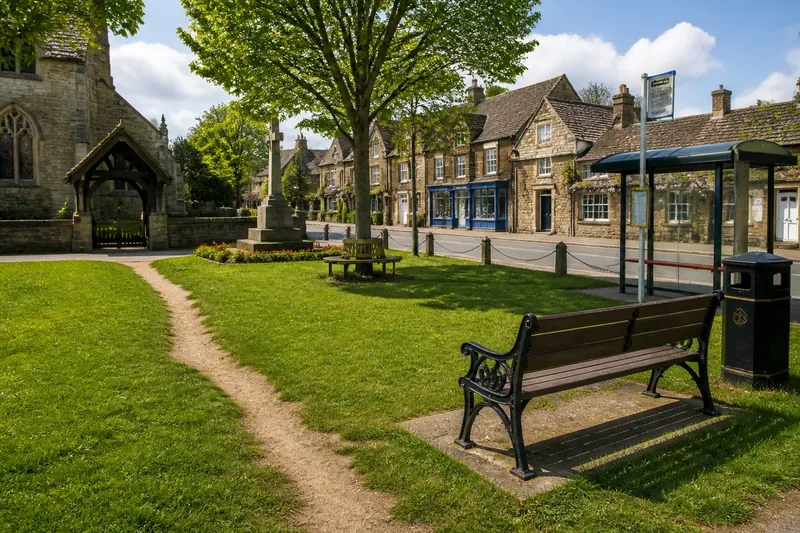
A worn path cuts across the village green, missing the formal gate by several paces. Nearby, a bench faces the bus stop rather than the view. Those small decisions are useful clues when reading a shared square or green: the layout records not only what a place was meant to do, but how people have made use of it since.
To trace those changes, start with what is visible, then compare routes, edges, fixtures and the space between them. The aim is not to assign an exact date to every feature. It is to notice which uses fit the layout, which seem to have faded, and what the space still accommodates.
Choose a vantage point
Begin at a place where you can see most of the open space without standing in the way of other people. A green’s entrance, a square’s corner or a public footpath beside the boundary can work. Take a slow look around before focusing on individual details.
First establish the broad shape. Is the ground an open lawn, a paved rectangle, a planted triangle or an irregular patch between roads and buildings? Note whether buildings face towards it, turn their backs, or form only one side. A square enclosed by shopfronts offers different possibilities from a green separated from homes by hedges, even if both have a central patch of open ground.
Then notice what occupies the middle. A tree, memorial, fountain, bandstand or empty stretch of paving can organise movement and attention. The centre might invite people to meet around it, or leave enough room for an event to take over temporarily. Do not assume that a prominent object has always been the focus. Later additions can redirect a familiar place without erasing older routes.
Stand where ordinary users might approach from. The view from a car park or a nearby pavement may reveal entrances and destinations that are easy to miss from the centre.
Read the routes
Paths are among the clearest signs of how a place is used. Look for surfaced walks, narrow tracks through grass, worn corners and lines of paving that connect entrances to particular doors or facilities. Compare these with any formal route shown by rails, edging or an avenue of trees. A path that takes a straight cut across a lawn may suggest a useful connection; it does not, by itself, identify who made it or when.
Trace each route in both directions. A path from a bus stop to a library can serve everyday errands; one from a church gate to a large open area may have a different pattern of use on particular occasions. Routes that meet at a central point may make the space a natural place to pause. If they pass through without converging, the open ground may function more as a corridor than a destination.
Look for changes in material and direction. A smooth strip may connect newer paving to an older track, while a path that bends around a tree may have been adjusted to accommodate it. Surface differences can also reflect access needs or maintenance choices, so treat them as evidence of a change in arrangement, not a precise account of its cause.
Imagine a green with a paved entrance from the high street, a diagonal grass track towards the school and a newer level path to a community hall. These visible connections suggest that the space links daily destinations as well as offering room to linger. They do not prove how often each route is used; watching the paths over a normal visit would show which connections are active at that moment.
Study the edges
Boundaries shape a shared space as much as its centre. Notice walls, railings, hedges, low kerbs and changes in pavement. Ask where the boundary is open, where it directs people through a gate, and where it makes the space feel separate from nearby streets. A clear entrance can turn arrival into a recognisable act; several informal gaps can make the space feel like part of an everyday route.
Next, look at what faces the open ground. Shop doors, house fronts, civic buildings and blank walls each imply a different relationship. Doors and windows can make the space feel watched and connected to daily life. A long blank edge may leave the centre more exposed, or make a route along the perimeter feel preferable. These are clues about present conditions, not a verdict on a place’s past.
Changes in edge treatment can mark the joining of different parts. For example, paving may continue past an old stone boundary, while a hedge stops short of a newer entrance. A small interruption may be more revealing than a grand gateway: it can show where people now cross, even if the older layout expected them to enter elsewhere.
Look from both sides of the boundary. A green can be open to walkers but screened from nearby homes; a square can be visually enclosed yet easy to enter. The distinction helps explain who can approach the space and how visible activity is from its surroundings.
Compare the fixtures
Fixtures show what a place is equipped to support. Note benches, litter bins, play equipment, drinking fountains, noticeboards, shelters, bicycle stands and lighting. Record their positions before judging their purpose. A bench beside a path may serve a passing walker; one facing a play area may support someone keeping an eye on children.
Consider whether the fixtures are concentrated or spread out. A cluster of seats near a noticeboard can support conversation or waiting. Scattered benches along a perimeter may favour short rests without gathering a crowd in the middle. Play equipment can give one section a specific use while leaving other parts available for walking, sitting or informal activity.
Notice the direction of seats and openings. Do benches face one another, the street, a view or a central object? Does a shelter look towards the open space or away from it? These choices affect what it feels natural to do. They may reflect later redesign, maintenance or practical constraints, so avoid reading intention into every angle.
Materials can help distinguish additions. Metal rails beside older stone edging, modern paving around a long-established tree or new signs on an old noticeboard may indicate that the space has been adapted in layers. The useful observation is that the arrangement is mixed, not that any one feature belongs to a particular period.
Watch the centre
The middle of a green or square can change function without changing its outline. A lawn might be left open for unstructured play, while a paved square can host a temporary stall or community event. Look for ground markings, sockets, removable posts, broad access points or an area kept clear of permanent fixtures. Such features can make temporary use easier, though they do not identify which events actually take place.
Pay attention to what the centre excludes as well as what it permits. A planted bed may divide foot traffic or provide a quiet focus. A memorial can encourage people to pause, while a large empty surface can accommodate movement and gathering. If a central feature forces people to walk around it, follow the route it creates and see where that route leads.
Use your visit to distinguish a space’s available uses from its observed uses. On a quiet morning, people may cross a square on the way to work. On another day, the same square may be set aside for a ceremony. The layout offers capacity and constraints; the activity you happen to see is only one moment in that pattern.
Ask what the layout reveals?
How can I tell whether a green is still used as a gathering place?
Look for places to pause, routes that converge and an open area that can accommodate people without blocking access. Then notice what is happening during your visit, while remembering that a quiet interval does not settle the question.
What does a worn path across the grass mean?
It shows that people have crossed that line often enough to leave a visible trace. The path may link useful destinations, but it cannot identify the walkers, explain their reasons or date the route on its own.
Can benches and signs reveal an older use?
They can show what the space is arranged to support now, and differences in material or placement may point to successive changes. For earlier uses, look for how fixtures relate to the wider layout rather than treating one object as a complete record.
Why does the square feel busy even when it is empty?
Several routes, doors and active edges can make movement feel likely even without a crowd. In contrast, blank boundaries or awkward entrances can make an open area feel detached from its surroundings.
Separate clues from claims
Once you have walked the space, sort your notes into three plain categories: what you can see, what it might suggest and what remains uncertain. “Two paths meet beside the hall” is an observation. “The junction may make this a convenient meeting point” is an interpretation. “People have always gathered here before events” would require evidence beyond the layout.
Where accessible, compare your observations with a local map, council information board or parish record. A map can help locate old boundaries or entrances; a noticeboard may describe current facilities and rules. If a source describes a past use, check whether its wording refers to this precise patch of ground or a nearby building. Local place names can cover more ground than they appear to.
Do not treat tidy design as proof of an original plan. A neat path can be recent, and an untidy corner can carry a practical function. Landscaped spaces are often revised to meet changing needs, maintain sightlines or make access easier. The present arrangement may preserve some old connections and obscure others.
Leave the space legible
Finish by choosing one feature that best explains the layout: perhaps a diagonal track, a gate aligned with a public building or benches gathered beside a sheltered edge. Describe how it relates to the surrounding routes and fixtures. That relationship is usually more informative than a list of objects.
For a useful record, make a simple sketch showing entrances, paths, central features and places to sit. Add brief notes about what you saw and mark any interpretation with words such as “may” or “suggests”. This leaves room for another visit, or for a local source, to alter the reading without requiring you to start again.
Reading a village green or shared square is less a matter of finding one hidden story than noticing how its parts fit together. The main path may explain an everyday shortcut; the edge may reveal a change in access; a clear centre may still make room for uses that leave no permanent mark. On your next visit, note which route people choose when the obvious entrance is not the nearest one. That small choice can tell you more about the space’s present life than its most imposing monument.